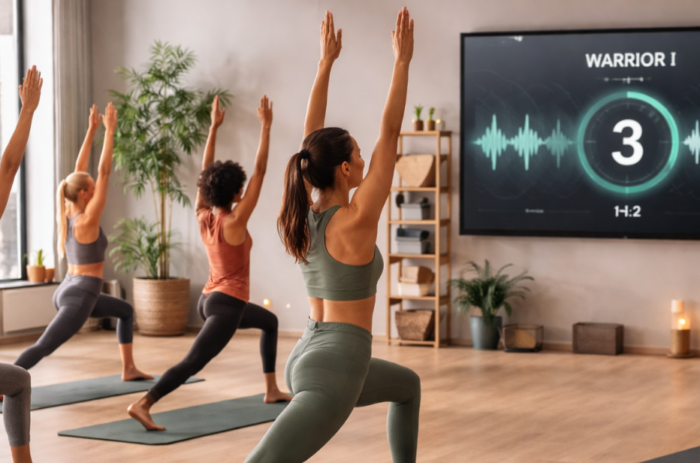
Research in group fitness settings shows that participants are far more likely to complete a class when instructions are easy to follow and timing feels predictable. Confusion during transitions or unclear pacing can quickly lead to frustration, especially for beginners. Have you ever joined a wellness class and spent the first ten minutes just trying to figure out what to do next? That small moment of uncertainty can shape the entire experience.
Improving member experience in wellness classes depends on how clearly participants understand instructions and how comfortably they can follow the rhythm of the session. Clear on screen guidance and well managed pacing create a sense of confidence that encourages members to stay engaged and return regularly.
Table of Contents
Why Clear Visual Guidance Matters in Wellness Classes

Visual guidance plays a central role in how members process information during movement based sessions. Verbal instructions alone often get lost in the noise of music, breathing, and movement. On screen guidance gives participants a stable reference point that supports learning and consistency.
Clear visual instructions typically improve the experience in several important ways:
- Members can follow exercises without constantly looking around for cues, which reduces stress and distraction.
- New participants gain confidence more quickly because they understand expectations from the beginning.
- Experienced members can maintain flow without interruptions caused by repeated explanations.
Many instructors notice that sessions run more smoothly when participants spend less time asking questions and more time moving. Simple visual cues such as timers, exercise names, and movement diagrams make classes feel organized and intentional.
Structured guidance also reduces the learning curve for people joining wellness classes for the first time.
Using Structured Effort Levels for Better Engagement
Members feel more secure when they understand how hard they are supposed to work. Effort levels that are explained visually help participants regulate intensity without guessing or overexerting themselves.
Many modern classes use structured intensity models based on Heart Rate Zones. Clear explanations help participants understand how intensity changes during the session.
Members who understand effort levels tend to pace themselves better and remain consistent across the entire class. Clear effort targets also reduce the risk of early fatigue.
A simple structure might include:
- Warm up phases with low intensity targets.
- Moderate work intervals that build endurance steadily.
- Higher intensity segments with clearly marked duration.
- Recovery periods that allow participants to reset.
Participants often report feeling more in control when intensity guidance is visible throughout the class.
Designing Clear On Screen Instructions
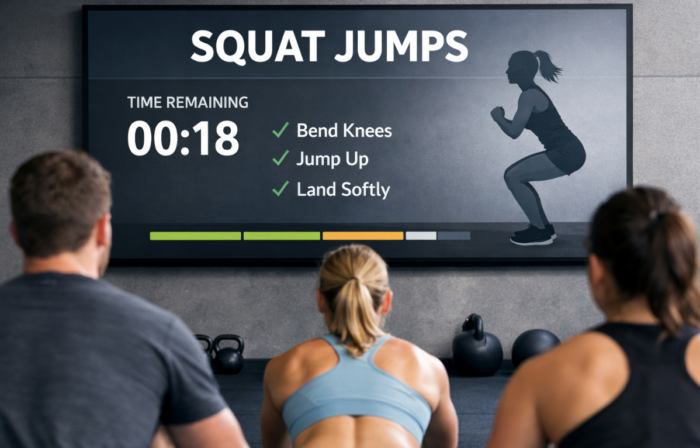
Wellness classes benefit from instructions that are simple and readable at a glance. Screens should support movement rather than distract from it.
Effective displays usually include a few essential elements:
- Exercise name shown in large readable text so members recognize movements quickly.
- Countdown timers that show how much time remains in each segment.
- Short movement reminders that reinforce correct technique.
- Visual progress indicators that help members anticipate transitions.
Screens that contain too much information can overwhelm participants. Clean design supports focus and reduces hesitation during transitions.
Example Layout for On Screen Guidance
| Element | Purpose | Recommended Style |
| Exercise Name | Quick recognition | Large bold text |
| Timer | Pacing awareness | Visible countdown |
| Effort Level | Intensity guidance | Color coded or numeric |
| Next Exercise | Transition clarity | Small preview area |
A simple layout helps members absorb information without breaking concentration. Consistency across sessions also helps returning members feel comfortable immediately.
Creating Natural Class Pacing
Pacing determines how members experience the flow of a session. Classes that move too quickly feel stressful. Classes that move too slowly feel disconnected and dull.
Good pacing creates a steady rhythm that participants can settle into after the first few minutes.
Instructors often improve pacing by focusing on predictable transitions:
- Each segment begins and ends on clear visual signals.
- Recovery periods appear at regular intervals.
- Exercise duration remains consistent across similar segments.
Predictable pacing reduces cognitive effort. Members stop worrying about what comes next and focus on performing movements correctly.
Did you know that predictable timing improves perceived effort? Participants often rate sessions as easier when intervals follow consistent patterns even if total workload remains the same.
Supporting Beginners Without Slowing Down Advanced Members

Mixed level wellness classes present a common challenge. Beginners need more guidance, while experienced participants want continuous flow. Clear on screen guidance helps instructors meet both needs simultaneously.
Beginners benefit from visual support that allows them to stay oriented during the class. Experienced members benefit from uninterrupted pacing.
Several approaches help balance these needs:
- Movement demonstrations can appear briefly before each segment starts so beginners understand what to do.
- Alternative difficulty options can be shown directly on screen for quick adjustments.
- Visual pacing cues allow experienced members to continue moving without waiting for explanations.
Wellness classes that support different ability levels tend to retain members longer because everyone feels included.
Clear instructional design reduces mental load. When participants spend less energy figuring out instructions, they can focus on movement quality and personal progress.
Balanced guidance creates a shared experience that works for a wide range of participants.
Using Visual Feedback to Keep Members Motivated
Motivation improves when participants can see their progress during a class. Visual feedback reinforces effort and creates a sense of achievement even within a single session.
Members respond especially well to feedback that shows progression across time segments.
Some useful feedback methods include:
- Progress bars that show how much of the session has been completed.
- Segment counters that track completed intervals.
- Effort indicators that confirm participants are staying within target ranges.
Visible progress reduces uncertainty and helps members stay engaged during longer sessions.
Simple Feedback Elements and Their Impact
| Feedback Type | Member Benefit | Result |
| Session Progress Bar | Clear sense of advancement | Higher completion rates |
| Interval Counter | Structured experience | Better pacing control |
| Effort Indicator | Confidence in intensity | Reduced overtraining risk |
Members often describe classes with visible progress as more satisfying because they can see how their effort adds up over time.
Avoiding Common Mistakes in On Screen Guidance
Poor screen design can reduce the effectiveness of wellness classes. Cluttered displays and unclear timing often create confusion rather than clarity.
Several common mistakes appear frequently in poorly structured sessions:
- Too much text forces members to stop moving in order to read instructions.
- Small fonts make information difficult to see from the back of the room.
- Inconsistent timing creates uncertainty during transitions.
- Rapid exercise changes leave little time for adjustment.
Reducing these problems usually leads to immediate improvements in member satisfaction.
Instructors who review recordings of their sessions often notice pacing problems that are not obvious during live instruction.
Measuring Improvements in Member Experience

Improving member experience in wellness classes works best when instructors track results over time. Clear metrics help identify which changes are working and where further improvement is needed.
Useful measurement methods often include both objective data and participant feedback.
Some helpful evaluation tools include:
- Attendance consistency across several weeks.
- Completion rates for longer classes.
- Participant feedback surveys focused on clarity and pacing.
- Instructor observation notes after each session.
Tracking these indicators makes improvements easier to sustain.
Final Perspective
Small adjustments often lead to noticeable improvements when applied consistently.
Wellness classes that prioritize clear on screen guidance and steady pacing often develop stronger communities because members feel comfortable and supported.
Participants return to sessions where they feel confident and successful. Clear instructions and predictable pacing remove unnecessary barriers and allow members to focus on what matters most, improving health and enjoying movement.
Improving member experience in wellness classes does not require complicated technology. Thoughtful design and consistent pacing can transform an ordinary class into a session that members look forward to each week.
Leave a Reply